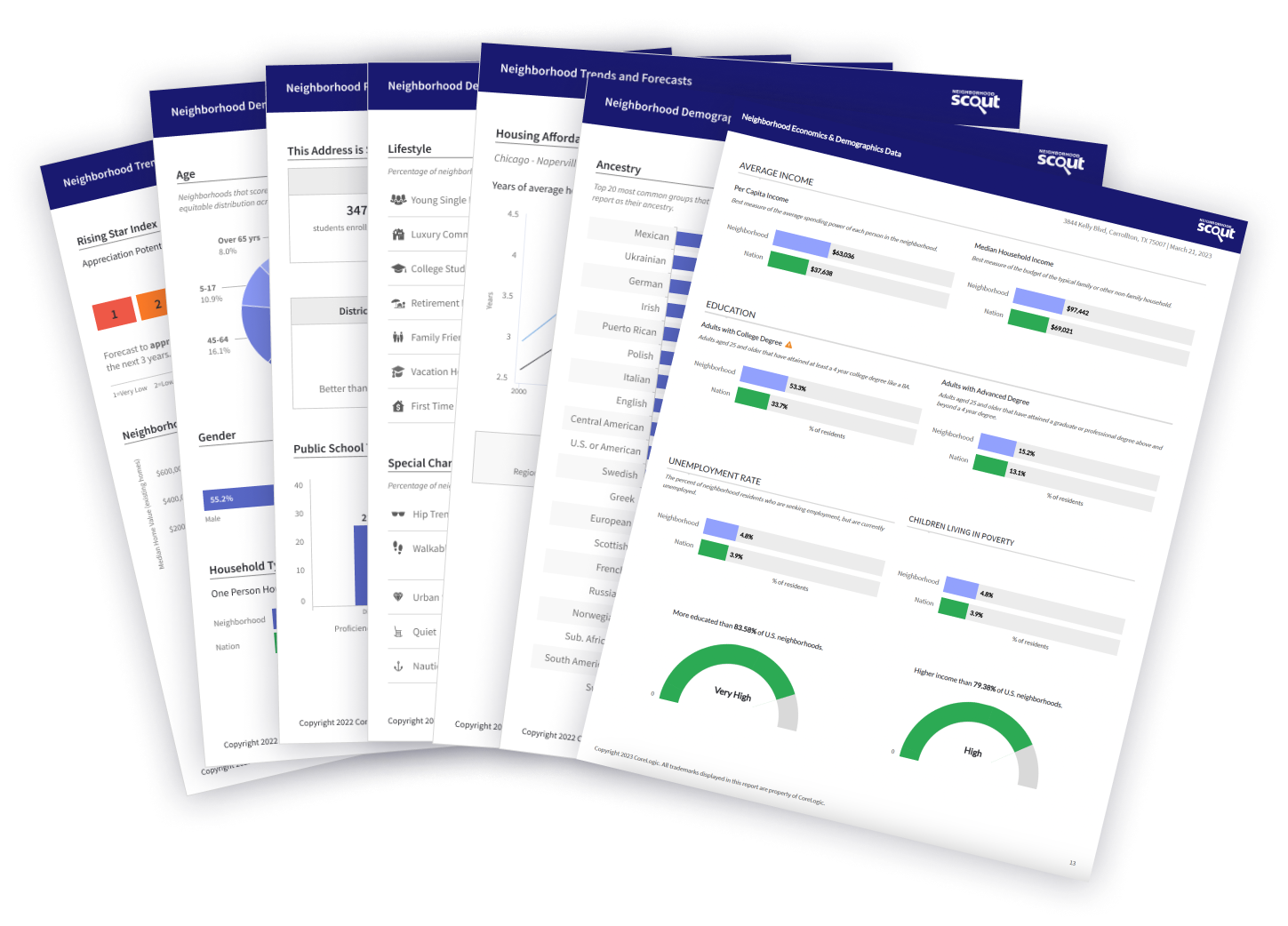
Nissequogue is a very small coastal village (i.e. on the ocean, a bay, or inlet) located in the state of New York. With a population of 1,625 people and just one neighborhood, Nissequogue is the 666th largest community in New York.
Nissequogue home prices are not only among the most expensive in New York, but Nissequogue real estate also consistently ranks among the most expensive in America.
Nissequogue is a decidedly white-collar village, with fully 95.22% of the workforce employed in white-collar jobs, well above the national average. Overall, Nissequogue is a village of managers, professionals, and sales and office workers. There are especially a lot of people living in Nissequogue who work in business and financial occupations (15.32%), management occupations (14.58%), and sales jobs (11.40%).
Telecommuters are a relatively large percentage of the workforce: 31.02% of people work from home. While this number may seem small overall, as a fraction of the total workforce it is high relative to the nation. These workers are often telecommuters who work in knowledge-based, white-collar professions. For example, Silicon Valley has large numbers of people who telecommute. Other at-home workers may be self-employed people who operate small businesses out of their homes.
Because of many things, Nissequogue is a very good place for families to consider. With an enviable combination of good schools, low crime, college-educated neighbors who tend to support education because of their own experiences, and a high rate of home ownership in predominantly single-family properties, Nissequogue really has some of the features that families look for when choosing a good community to raise children. Is Nissequogue perfect? Of course not, and if you like frenetic nightlife, it will be far from your cup of tea. But overall this is a solid community, with many things to recommend it as a family-friendly place to live.
One of the nice things about Nissequogue is that it is nautical, which means that parts of it are somewhat historic and touch the ocean or tidal bodies of water, such as inlets and bays. Because of this, visitors and locals will often go to these areas to take in the scenery or to enjoy waterfront activities.
If knowledge is power, Nissequogue is a pretty powerful place. 64.09% of the adults in Nissequogue have earned a 4-year college degree, masters degree, MD, law degree, or even PhD. Compare that to the national average of 21.84% for all cities and towns.
The per capita income in Nissequogue in 2022 was $98,261, which is wealthy relative to New York and the nation. This equates to an annual income of $393,044 for a family of four.
Nissequogue is a very ethnically-diverse village. The people who call Nissequogue home describe themselves as belonging to a variety of racial and ethnic groups. The greatest number of Nissequogue residents report their race to be White, followed by Black or African-American. Nissequogue also has a sizeable Hispanic population (people of Hispanic origin can be of any race). People of Hispanic or Latino origin account for 12.06% of the village’s residents. Important ancestries of people in Nissequogue include Italian, Irish, German, Polish, and English.
The most common language spoken in Nissequogue is English. Other important languages spoken here include Spanish and Chinese.
The way a neighborhood looks and feels when you walk or drive around it, from its setting, its buildings, and its flavor, can make all the difference. This neighborhood has some really cool things about the way it looks and feels as revealed by NeighborhoodScout's exclusive research. This might include anything from the housing stock to the types of households living here to how people get around.
is a neighborhood that is on the ocean, a bay, or inlet. Many times, such places have amenities that bring locals and visitors to the waterfront for recreational activities or to check out the scenery. In some densely populated areas that are less financially well-off, the neighborhood waterfront can be relatively industrial and less open to recreation. In addition to being coastal, is a very nautical neighborhood, meaning that it is somewhat historic, walkable, densely populated and on the water. This gives the neighborhood a very nautical feel, with some seaside and shipping feel, which some may really enjoy the sights and sounds of.
In addition, one way that the neighborhood really stands out, is that it has more large 4, 5, or additional bedroom homes and real estate than 97.8% of the neighborhoods in America. When you walk or drive around this neighborhood, you'll instantly notice the size of the homes here which definitely makes a strong visual statement.
Furthermore, some neighborhoods are made up of apartments. Some consist of row houses, and most - by far - consist of a mixture of housing types. But the neighborhood stands out due to the total dominance of detached, single-family homes here. There are nearly no other types of residential real estate in the neighborhood. In fact, this neighborhood has a higher proportion of single-family homes in its real estate stock than 97.4% of all American neighborhoods.
Wealth makes most things in life easier, and a few things harder. If you are wealthy and enjoy keeping up with the Jones', this neighborhood will interest you. In fact, according to NeighborhoodScout's research, the neighborhood is wealthier than 98.6% of the neighborhoods in the United States. Residents here are truly in a unique situation even when compared to other Americans, based on the sheer amount of wealth concentrated here. Even in times of economic downturn, residents of this neighborhood, as a group, suffered less and recovered more quickly. This is indeed a stand-out characteristic of this neighborhood.
In addition, according to NeighborhoodScout's exclusive analysis, is among the best neighborhoods for families in New York. In fact, this neighborhood is more family-friendly than 97.9% of neighborhoods in the entire state of New York. Its combination of top public schools, low crime rates, and owner-occupied single family homes gives this area the look and feel of a "Leave It to Beaver" episode. Many other families also live here, making it easy to socialize and develop a strong sense of community. In addition, the high number of college-educated parents influences the academic success of the local schools. Overall, you will find all of the amenities a family needs to thrive in the neighborhood. In addition to being an excellent choice for families with school-aged children, this neighborhood is also a very good choice for urban sophisticates, highly educated executives and active retirees.
Did you know that the neighborhood has more Italian and Greek ancestry people living in it than nearly any neighborhood in America? It's true! In fact, 25.1% of this neighborhood's residents have Italian ancestry and 2.9% have Greek ancestry.
There are two complementary measures for understanding the income of a neighborhood's residents: the average and the extremes. While a neighborhood may be relatively wealthy overall, it is equally important to understand the rate of people - particularly children - who are living at or below the federal poverty line, which is extremely low income. Some neighborhoods with a lower average income may actually have a lower childhood poverty rate than another with a higher average income, and this helps us understand the conditions and character of a neighborhood.
The neighbors in the neighborhood in Nissequogue are wealthy, making it among the 15% highest income neighborhoods in America. NeighborhoodScout's exclusive analysis reveals that this neighborhood has a higher income than 98.6% of the neighborhoods in America. In addition, 0.6% of the children seventeen and under living in this neighborhood are living below the federal poverty line, which is a lower rate of childhood poverty than is found in 79.7% of America's neighborhoods.
What we choose to do for a living reflects who we are. Each neighborhood has a different mix of occupations represented, and together these tell you about the neighborhood and help you understand if this neighborhood may fit your lifestyle.
In the neighborhood, 56.9% of the working population is employed in executive, management, and professional occupations. The second most important occupational group in this neighborhood is sales and service jobs, from major sales accounts, to working in fast food restaurants, with 26.3% of the residents employed. Other residents here are employed in clerical, assistant, and tech support occupations (9.4%), and 7.3% in manufacturing and laborer occupations.
The most common language spoken in the neighborhood is English, spoken by 88.8% of households. Some people also speak Spanish (3.1%).
Culture is the shared learned behavior of peoples. Undeniably, different ethnicities and ancestries have different cultural traditions, and as a result, neighborhoods with concentrations of residents of one or another ethnicities or ancestries will express those cultures. It is what makes the North End in Boston so fun to visit for the Italian restaurants, bakeries, culture, and charm, and similarly, why people enjoy visiting Chinatown in San Francisco.
In the neighborhood in Nissequogue, NY, residents most commonly identify their ethnicity or ancestry as Italian (25.1%). There are also a number of people of Irish ancestry (15.1%), and residents who report German roots (12.6%), and some of the residents are also of Asian ancestry (5.4%), along with some English ancestry residents (4.6%), among others. In addition, 11.3% of the residents of this neighborhood were born in another country.
How you get to work – car, bus, train or other means – and how much of your day it takes to do so is a large quality of life and financial issue. Especially with gasoline prices rising and expected to continue doing so, the length and means of one's commute can be a financial burden. Some neighborhoods are physically located so that many residents have to drive in their own car, others are set up so many walk to work, or can take a train, bus, or bike. The greatest number of commuters in neighborhood spend between 15 and 30 minutes commuting one-way to work (32.8% of working residents), which is shorter than the time spent commuting to work for most Americans.
Here most residents (59.9%) drive alone in a private automobile to get to work. In addition, quite a number also carpool with coworkers, friends, or neighbors to get to work (5.3%) . In a neighborhood like this, as in most of the nation, many residents find owning a car useful for getting to work.